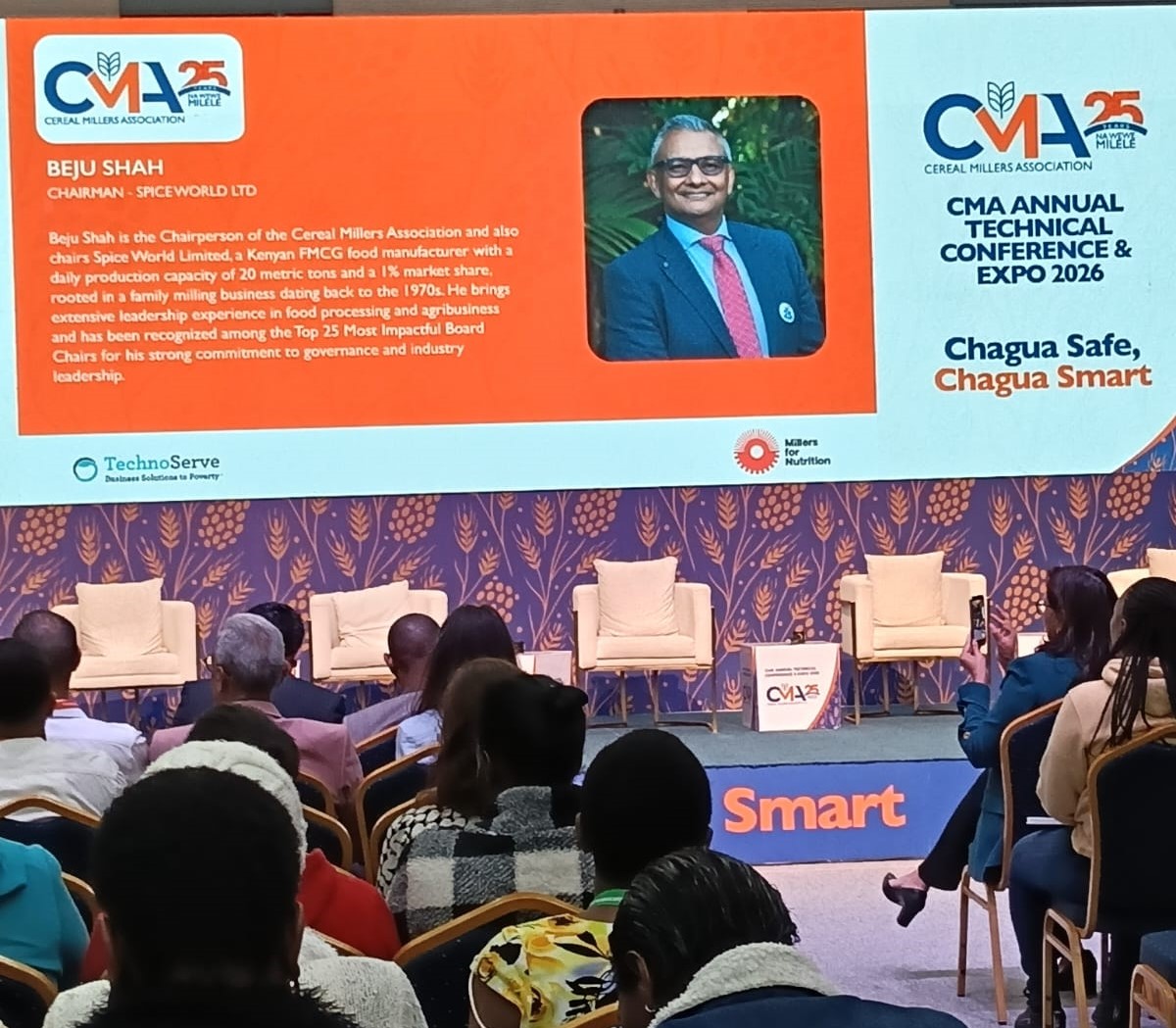
The Cereal Millers Association has pledged to clean up Kenya’s critical flour industry. Speaking at the 2026 Annual Technical Conference & Expo at Sarit Center in Nairobi, CEO Paloma Fernandes said CMA partners and members have made a commitment to address ongoing industry challenges, including contamination, testing gaps, and the risks posed by informal market channels.
With millers under the association accounting for roughly 40 percent of Kenya’s maize milling and 95 percent of wheat processing, the organization’s influence stretches across millions of households in the country.


Ms Fernandes acknowledged that the sector is grappling with deep-rooted challenges that threaten both consumer health and confidence.
The Invisible Danger in Everyday Food
At the heart of the crisis is aflatoxin contamination, an invisible but highly dangerous toxin that continues to infiltrate Kenya’s food chain. Fernandes says the scale of the problem calls for stronger mitigative mechanisms.
“We currently represent over 60 millers in Kenya and about 40% of maize production in the country. As such, We have a huge responsibility to Kenyan consumers in terms of food safety and overall trust. We are working closely with stakeholders across every part of the country to strengthen safety checks and testing mechanisms that will greatly benefit the current consumer and future generations,” said Ms Fernandes.
Historical data underscores her concern. Studies by the World Health Organization and Kenya’s regulatory agencies have shown that aflatoxin exposure remains a persistent threat in East Africa. In 2012, industry findings revealed that 65 percent of flour and more than half of peanuts on Kenyan shelves were contaminated, with traces even detected in milk.
While improvements have been made, the situation remains far from resolved. Today, millers under the Cereal Millers Association still reject between a quarter and a third of all maize delivered to their facilities due to unsafe toxin levels. “Every truck that comes in, we have to test,” Fernandes explained. “Whatever we reject… we have to reject it,” she adds.
The problem, however, does not end there. Much of the rejected grain finds its way back into informal markets, where regulatory oversight is minimal. “There are a lot of others who are happily receiving contaminated grain,” she warned, highlighting a dangerous loophole that continues to expose consumers to health risks.
Nutrition Crisis Beyond Contamination
Beyond food safety, Kenya is also facing a persistent nutrition challenge. According to data from UNICEF and the Kenya National Bureau of Statistics, about 26 percent of children under five are stunted, while 11 percent are underweight. Micronutrient deficiencies, including iron and folic acid, remain widespread.
Fernandes described these figures as unacceptable, noting the scary prospects of the narrative. She emphasized that the Cereal Millers Association is working to ‘change the narrative of nutrition in Kenya’ through strict adherence to food fortification standards.
Although fortification of staple foods became mandatory in 2012, compliance is uneven across the market. Larger millers have largely embraced the requirements, but gaps persist in informal sectors, where many vulnerable consumers purchase their food.
Cereal Millers Association Struggle for Fairness in the Market
An imbalance between compliant and non-compliant players in Kenya remains a thorny issue for regulators and stakeholders. While members of the Cereal Millers Association invest heavily in testing, quality assurance, and fortification, they face competition from operators who bypass these safeguards.
Fernandes pointed to this disparity as a major obstacle to sustainable progress. “It’s not business as usual. We want to do the right thing,” she said, adding that self-regulation alone is not enough without industry-wide enforcement. She called on regulators to ensure a level playing field, stressing that “everybody’s products need to be tested for aflatoxins” and that all millers must comply with fortification requirements.
The lack of uniform enforcement not only undermines responsible businesses but also erodes consumer trust in packaged flour products.
Innovation and Responsibility Across the Value Chain
Despite the challenges, the Cereal Millers Association is investing in solutions that extend beyond the factory floor. Fernandes emphasized the importance of tackling contamination at its source, particularly at the farm level. “Let’s sort it out at farm level. Let’s not come to the end process and blame the person at the end for the problem.”
The association is working closely with farmer groups and research institutions to promote the use of Aflasafe, a biological control method that reduces aflatoxin contamination in soil. At the same time, millers are exploring new technologies, including rapid testing kits and ozone-based decontamination methods.
These efforts reflect a broader shift toward a more integrated approach, where responsibility for food safety is shared across the entire supply chain.
Rebuilding Trust Through Transparency
Recognizing that consumers cannot see the rigorous processes behind food production, the Cereal Millers Association is also developing a new Mark of Quality to signal compliance and safety.
Fernandes explained that this mark will go beyond existing certifications to include aflatoxin testing, fortification compliance, and other regulatory standards. “It’s going to include everything,” she said, describing it as an evolving system designed to keep pace with emerging risks.
To address concerns about counterfeiting, the association is even considering the use of QR codes, enabling consumers to verify product authenticity and trace quality assurance processes in real time.
A Defining Moment for Food Safety
With Kenya’s grain sector feeding over 40 million people daily, the consequences of inaction are too great to ignore.
The path forward will require stronger enforcement, deeper collaboration, and greater consumer awareness. But as the industry confronts its challenges head-on, the question of trust remains a going concern among many Kenyans
ALSO READ: I&M Bank Opens New Branch In Mwea, Targets Kirinyaga’s Agriculture Sector