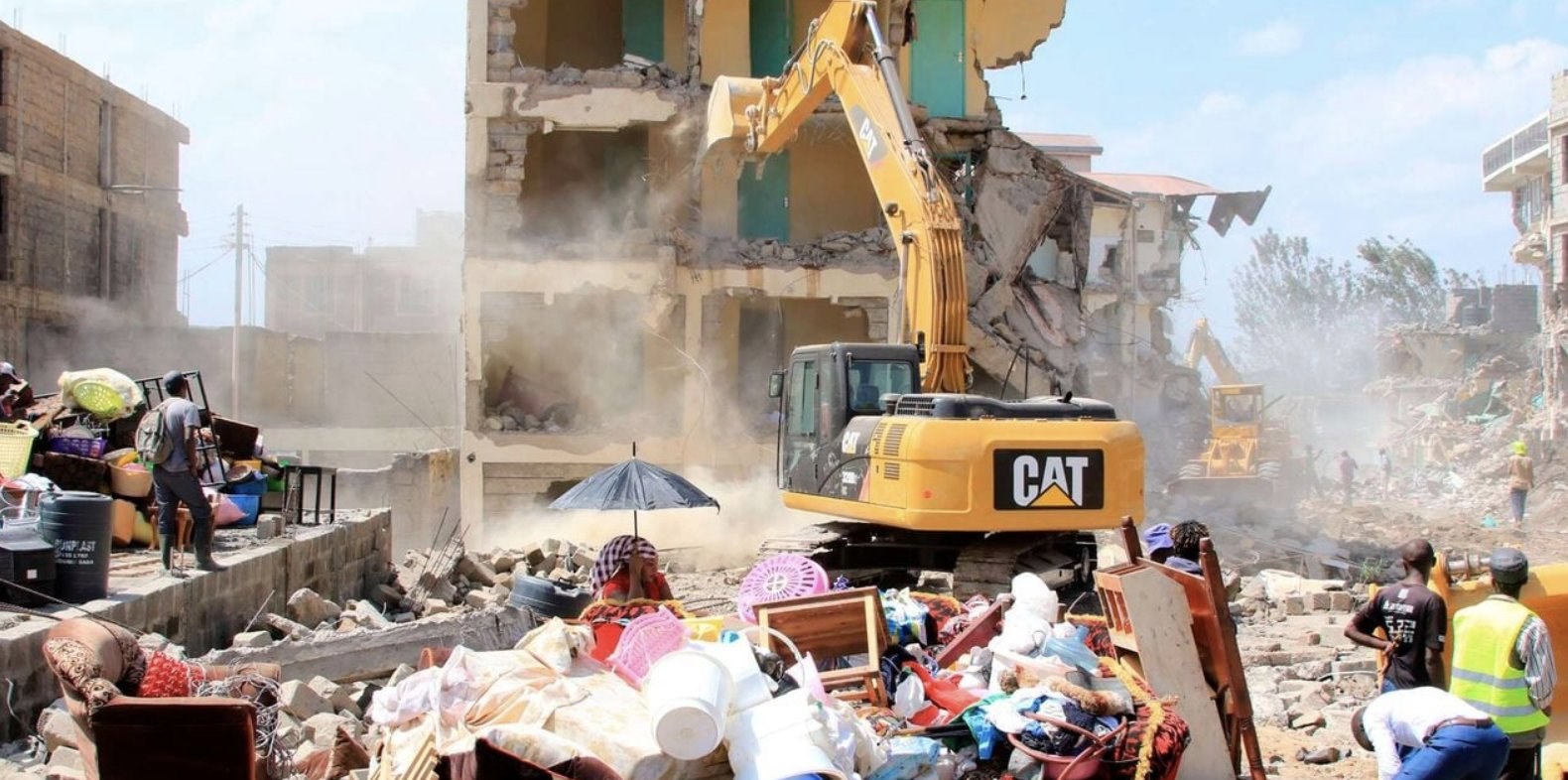
The Institution of Surveyors of Kenya (ISK) has raised concerns over the ongoing demolitions in Nairobi along Nairobi’s riparian reserves, cautioning the government against violating constitutional property rights in the process.
In a press statement released on May 5, 2026, the professional body expressed support for the government’s efforts to restore and protect water bodies under the Nairobi Rivers Regeneration Project, spearheaded by the Ministry of Lands, Public Works, Housing and Urban Development.


However, ISK warned that inconsistencies in legal definitions and technical standards governing riparian land have created confusion and conflict.
The statement comes amid recent remarks by Nairobi Governor Johnson Sakaja and heightened demolitions targeting structures deemed to be on riparian reserves, actions that have sparked public outcry and legal questions.
ISK pointed out that riparian reserves are often wrongly assumed to be public land, emphasizing that some affected properties were legally acquired and developed based on approved survey plans. The body stressed that where land was lawfully owned, any repossession should follow due process, including proper valuation, gazettement, and full compensation as required under the Constitution.
“Any retroactive application of new riparian definitions to deprive landowners of property without compensation amounts to compulsory acquisition and is unconstitutional,” the statement noted.
Conflicting Laws On Demolitions in Nairobi
At the same time, ISK distinguished such cases from illegally acquired or fraudulently developed properties, which it said do not qualify for compensation and can be lawfully removed.
The surveyors also highlighted broader systemic issues, including conflicting laws, unclear measurement standards, and lack of coordinated policy on riparian management. These gaps, they argued, have contributed to encroachment, environmental degradation, and disputes over enforcement.
To address the crisis, ISK called for urgent harmonization of laws, clear technical guidelines, and greater public participation in decision-making. It also urged the government to prioritize sustainable flood management solutions, such as improved drainage systems, proper urban planning, and stricter enforcement of development regulations.
As flooding continues to affect parts of Nairobi, the institution warned that environmental protection must be balanced with respect for property rights and the rule of law.
ISK reaffirmed its readiness to work with government agencies, county authorities, and communities to ensure that riparian reserve management is both legally sound and environmentally sustainable.
The recent wave of demolitions in Nairobi reflects a long-running tension between environmental protection, urban planning failures, and constitutional property rights. While the Nairobi Rivers Regeneration Project seeks to restore degraded waterways and reduce flood risk, the process has exposed deep structural problems in how land in the city has been planned, allocated, and regulated over decades.
Data from the Kenya National Bureau of Statistics (KNBS) shows that Nairobi’s population has expanded rapidly, from about 2.1 million in 1999 to over 4.4 million in the 2019 census, placing intense pressure on land, housing, and infrastructure. This growth has outpaced formal urban planning, contributing to the proliferation of informal settlements and unregulated developments, many of which have encroached on riparian reserves and other environmentally sensitive areas.
At the same time, reports by the World Bank indicate that over 60% of Nairobi’s residents live in informal settlements occupying less than 10% of the city’s land. These areas are often located along river corridors such as the Nairobi, Ngong, and Mathare rivers, making them highly vulnerable to flooding. The situation worsens during heavy rains, as seen in 2024 when floods affected tens of thousands of households in Nairobi and other parts of Kenya, according to government disaster response data.
The demolitions in Nairobi must also be understood within the legal framework of the Constitution of Kenya 2010, which protects the right to property under Article 40 but allows compulsory acquisition for public purposes—provided due process is followed and prompt, full compensation is paid. This is where much of the controversy lies. In many cases, affected landowners argue that they obtained approvals from relevant authorities, raising questions about institutional accountability when the same state later declares such developments illegal.
A key issue highlighted by experts, including the Institution of Surveyors of Kenya, is the lack of a universally applied and clearly defined standard for riparian boundaries. Different agencies have historically used varying benchmarks, such as fixed distances (e.g., 6 to 30 metres from riverbanks) versus hydrological measures like the high-water mark. This inconsistency has created legal grey areas that complicate enforcement and expose the government to litigation.
One notable legal precedent is the case involving East African Portland Cement Company, where disputes over land ownership and alleged encroachment led to prolonged court battles and demolitions in Athi River. The courts emphasized the need for clear land records and lawful procedures, reinforcing that even where land is irregularly allocated, the state must follow due process in repossession.
Another relevant ruling came from the Environment and Land Court of Kenya, which has in multiple decisions held that demolitions carried out without adequate notice, consultation, or resettlement plans violate constitutional protections. In some cases, courts have issued injunctions stopping evictions until proper procedures are followed, underscoring the judiciary’s role as a check on executive action.
Beyond legality on demolitions in Nairobi, there is a significant economic dimension. According to analysis by the Kenya Institute for Public Policy Research and Analysis, unclear land tenure and weak enforcement of planning regulations increase the cost of doing business, discourage investment, and contribute to urban inefficiencies. When demolitions occur abruptly, they also destroy livelihoods, particularly for small businesses operating in affected buildings, deepening economic vulnerability.
Environmental considerations, however, remain urgent. Studies by the United Nations Environment Programme have shown that riparian encroachment significantly reduces river capacity, increases pollution, and heightens flood risks. In Nairobi, decades of encroachment have narrowed river channels and blocked natural drainage systems, making periodic flooding almost inevitable.
ALSO READ: How Institutional Real Estate Investment Can Drive Affordable Housing