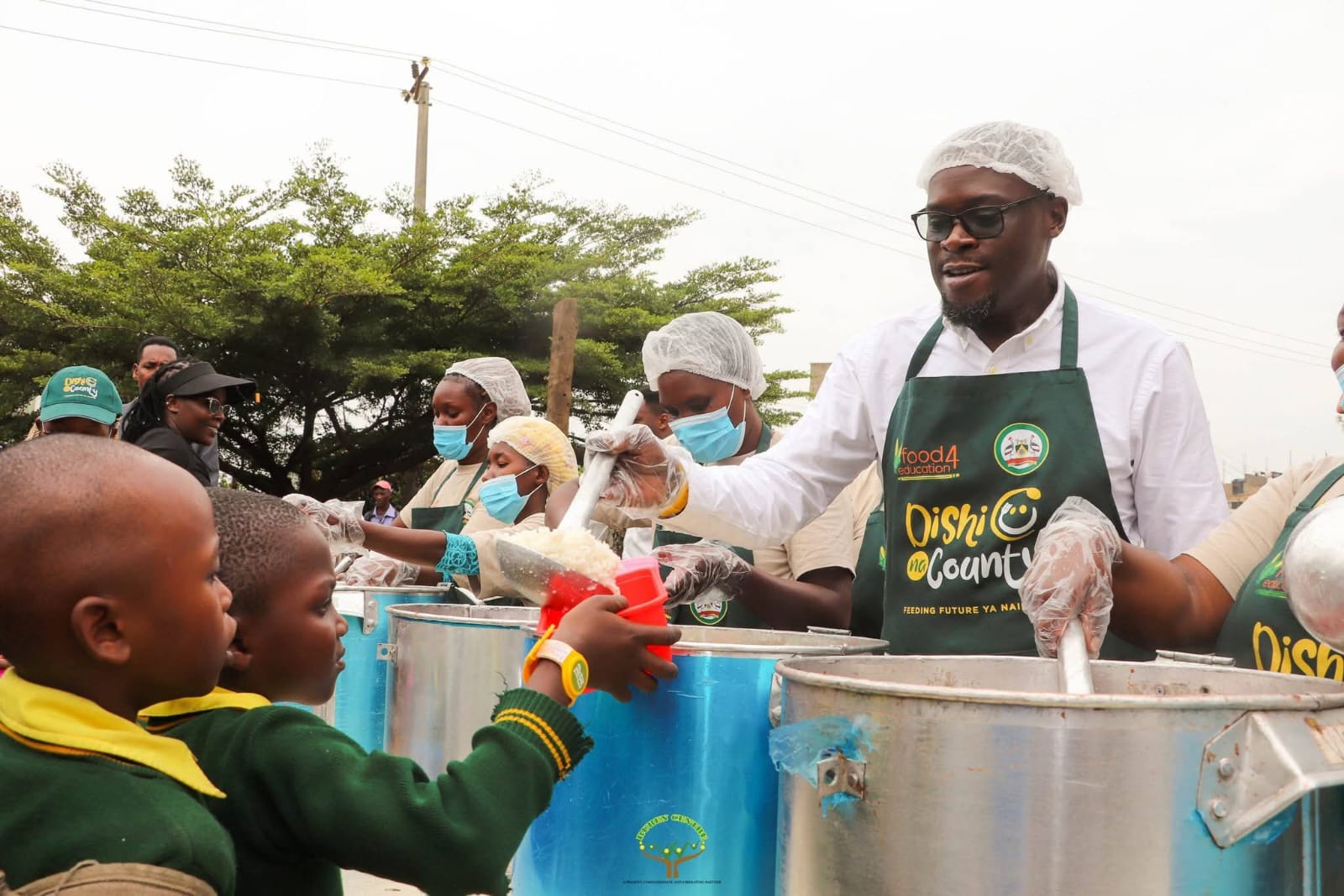
Nairobi Governor Johnson Sakaja’s Dishi Na County, a flagship school feeding program targeting public primary schools within Nairobi County, is now delivering more than 310,000 nutritious meals to vulnerable pupils, accompanied by an executive bursary scheme that is helping to cushion the wider costs of schooling. Since its launch in August 2023, the program has become a central piece in Nairobi City County’s efforts to improve child health, school attendance and academic outcomes.
Hunger in the Classroom Is A Perennial Challenge
Before Dishi Na County was introduced, hunger was a stark reality for many learners in Nairobi’s public schools. County officials observed that a significant number of pupils arrived at school without having eaten, a situation linked with low attention spans, frequent absenteeism and poor academic results. It was estimated that as recently as 2023 one in every four learners attended class hungry, undermining efforts to boost enrolment and success rates across the city’s education system.


Devolution in Kenya had placed many education-adjacent services at the county level, creating a space for local experimentation and targeted interventions. Within this policy landscape, the need for a structured program that tackled both food insecurity and education outcomes became a priority for Nairobi’s leadership.
Background of Dishi Na County
The Dishi Na County initiative was conceptualized by Nairobi Governor Johnson Sakaja as part of his administration’s manifesto commitments and cabinet approvals in 2023. Officially launched in August 2023, the program sought to provide daily, hot and nutritious meals to learners in public primary schools and Early Childhood Development Education (ECDE) centres throughout the county.
The name itself, a blend of Kiswahili words that roughly translate to “eat with the county” reflects its intent: to ensure no child’s education is compromised by hunger. From inception, Dishi Na County was positioned as a county-led school feeding initiative, designed with local priorities and implemented through an intricate operational structure involving centralized kitchens and digital solutions.
Operational Model and Tech Integration
At the heart of Dishi Na County’s delivery model is a network of 17 central kitchens, one serving each of Nairobi’s sub-counties. These kitchens prepare fresh meals daily and distribute them to participating schools across the city, adhering to nutrition standards intended to support learning and overall child health.
To facilitate efficient transactions and track participation, the program uses a tech-driven Tap2Eat system. Under this model, parents or guardians load funds via mobile money into a virtual wallet linked to their child’s Near Field Communication (NFC) wristband. Pupils “tap to eat” at lunchtime, allowing real-time data recording and reducing administrative bottlenecks at schools.
The cost of a meal under Dishi Na County is intentionally set at a nominal KSh 5 per plate, a highly subsidized price calibrated to ease financial burdens on families. For children from households that cannot pay even this minimal amount, the county government covers the full cost; an approach that emphasises inclusivity and aims to remove financial barriers to nutrition.
Over its first years of implementation, Dishi Na County expanded rapidly. Initially feeding around 80,000 learners in a phased rollout, the programme quickly scaled to reach over 310,000 pupils daily across more than 230 public schools by late 2024 and through 2025.
This expansion was accompanied by growing infrastructure investments, with central kitchens strategically placed to support distribution citywide. Plans to institutionalize the program, driven by formal policy development such as the Nairobi City County School Feeding Policy, 2025, aim to embed the approach within broader county service delivery frameworks, potentially increasing predictability of funding and cross-sector collaboration.
Dishi Na County’s Ongoing Impact
While Dishi Na County is still a relatively recent intervention, emerging data and testimonials from schools, community members, and education authorities point to clear improvements in both educational and health outcomes in areas where the program has been rolled out.
One of the most immediate effects has been a noticeable rise in school attendance. Many participating schools report more consistent daily attendance, a change widely attributed to the assurance that pupils will receive a meal during the school day, reducing absenteeism linked to hunger.
Enrolment levels have also increased, as parents increasingly view the availability of affordable school meals as a practical incentive to enrol their children in public schools and keep them there. In some cases, schools have reported dramatic growth, with enrolment more than doubling within a short period after joining the program.
Teachers and school administrators further note improvements in academic engagement, with pupils showing better concentration and participation in class. These gains are often accompanied by broader signs of improved well-being among children who now receive regular, nutritious meals at school.
Nutrition and public health experts note that for many learners, Dishi Na County meals may be the most balanced meal they receive all day, thereby addressing latent malnutrition and its associated learning deficits.
Nairobi County School Feeding Policy 2025
As Dishi Na County has grown, debates around school feeding policy have also surfaced. At the national level, proposals to scrap or scale back the national government’s own feeding programs have raised concerns among some lawmakers and child welfare advocates, pointing to the continued need for structured school nutrition support.
In Nairobi, efforts to formalize the program through the School Feeding Policy 2025 signal a move toward institutionalizing county-based nutrition initiatives in education. If ratified, the policy would legally anchor Dishi Na County in local governance structures and enable more predictable financing mechanisms, potentially unlocking further partnerships with national agencies, private sector actors, civil society and international partners.
There are also discussions around extending the program to include children in informal schools, which are currently outside the official beneficiary network due to budget and infrastructure considerations. Such expansion would require additional kitchens or alternative distribution strategies, a challenge Nairobi’s leaders say they are exploring.
Formal Policy Backing Could Be Crucial For Sustainability
As Dishi Na County approaches its third year, key considerations centre on sustainability, financing and equity. Securing stable budget lines within county financial plans and formal policy backing is seen as critical to the program’s continued success. Advocates argue that the program’s broader benefits, from improved health to stronger educational outcomes, justify its integration into long-term planning.
Critics and watchdog groups have also called for transparency and strong oversight, especially given the scale of public funds involved in operating mass meal preparation and distribution systems. Discussions around accountability, procurement, and audit mechanisms are ongoing in county assemblies and public forums.
The Dishi Na County program stands as a compelling example of how targeted, locally driven initiatives can address complex challenges at the intersection of nutrition, education, and social protection. While operational hurdles and policy debates persist, the evidence suggests that providing daily nutritious meals to learners can have measurable benefits for attendance, learning outcomes and wider child wellbeing.
As Nairobi City County continues to refine and expand the initiative, the experience of Dishi Na County is likely to remain a reference point in discussions about sustainable school feeding policies in Kenya and beyond, not as promotion, but as a case study in solving entrenched hunger and education barriers through structured, data-driven public action.
ALSO READ: Nairobi MCAs Table 20 Charges For Sakaja Impeachment