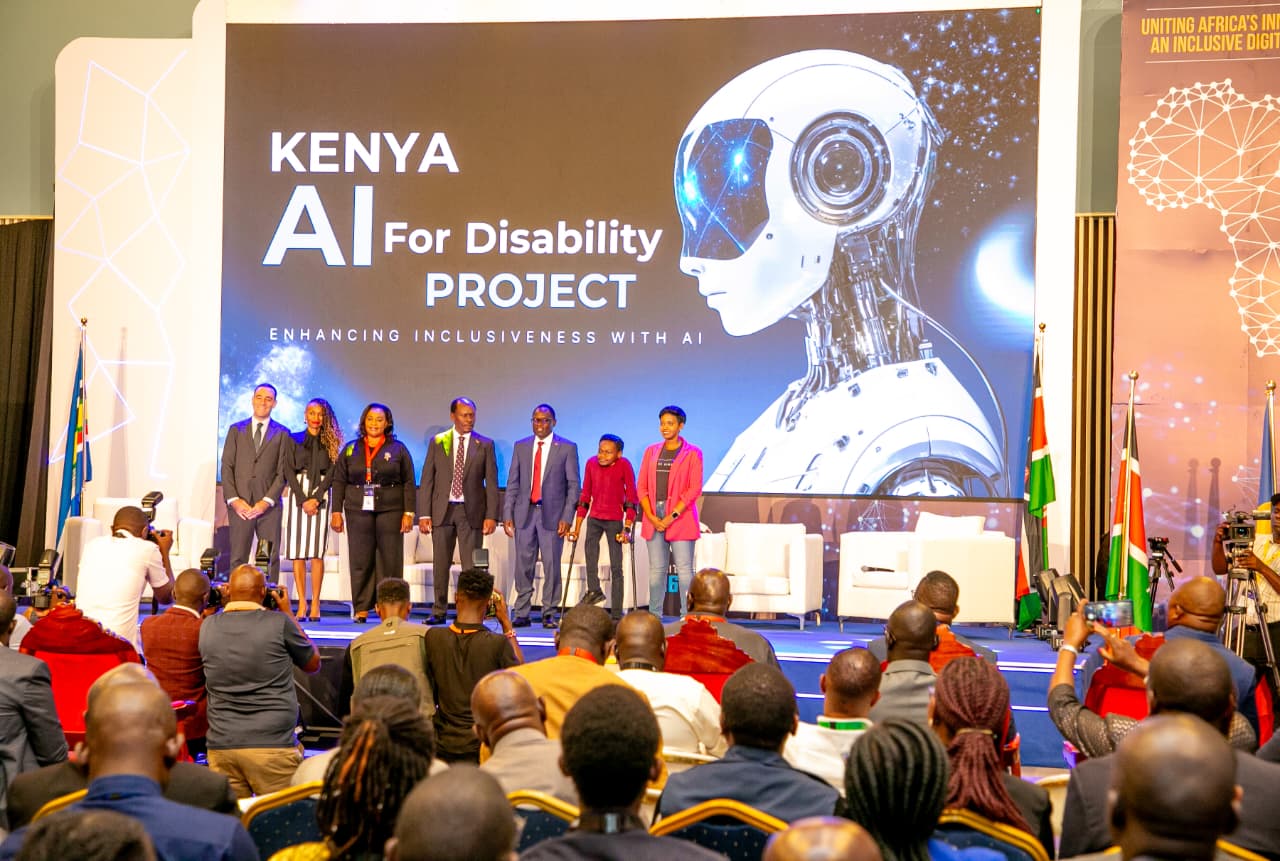
Ministry of Information, Communications and the Digital Economy has unveiled a landmark AI for disability project aimed at transforming how technology serves persons with disabilities, marking a significant step in embedding inclusivity at the core of the country’s digital transformation agenda.
The project was officially launched in Nairobi during the closing ceremony of the Connected Africa Summit 2026, bringing together government, industry, and civil society actors in a coordinated push to design accessible digital solutions from the ground up.


The initiative is being implemented in partnership with Kenya Institute of Special Education (KISE), Qhala, inABLE, Assistive Technologies for Disability Trust, and Huawei.
Speaking during the launch, Cabinet Secretary for Information, Communications and the Digital Economy, Hon. William Kabogo, emphasized that the initiative reflects Kenya’s broader commitment to building an inclusive digital economy where no one is left behind. Further, he urged African countries to shift from Inclusion as Aspiration to Inclusion by Design.
“As Africa advances its digital agenda, we must remain deliberate in our approach. Africa must be at the table – not on the menu – in shaping solutions powered by emerging technologies. This initiative is part of our commitment to ensuring that every Kenyan has an opportunity to participate in the digital economy – whether through innovation, employment, or entrepreneurship. We are moving from commitments to delivery,” he said.
The initiative marks a significant milestone in Africa’s digital transformation journey, positioning inclusion not as a policy aspiration but as a design principle embedded within technology, infrastructure, and innovation ecosystems.
The project is a multi-stakeholder collaboration model, with the Government of Kenya, through the Ministry of Information, Communications and the Digital Economy (MoICDE), playing a central role alongside technical and innovation partners in co-designing scalable assistive technologies that address real-world barriers faced by persons with disabilities.
Secretary for ICT, E-Government and Digital Economy, Mary Kerema, underscored that the project represents a structural shift in how government designs and delivers digital services.
“The AI for Disability Project marks a decisive shift from inclusion as an aspiration to inclusion by design. It brings together a powerful coalition of disability experts, innovation leaders, and global technology partners to address real, lived challenges faced by persons with disabilities,” she said.
She noted that MoICDE is not only facilitating the initiative but is actively co-engineering solutions with partners.
“As government, we are deliberately re-engineering our systems to be inclusive embedding accessibility into our digital infrastructure, platforms, and services from the outset, rather than retrofitting it later,” she added.
Founder and Executive Director of inABLE, Irene Mbari-Kirika, welcomed the partnership, describing it as a critical step toward addressing long-standing barriers faced by persons with disabilities in education, employment, and digital participation through Assistive Innovation.
“For too long, persons with disabilities have been excluded from the digital economy not because of lack of ability, but because systems were not designed with them in mind. This initiative changes that reality by bringing co-creation, innovation, and accessibility together at scale,” she said.
She emphasized that inclusive technology is not only a rights issue but also an economic imperative, unlocking untapped talent and productivity.
The project brings together a strong coalition of partners, including the Ministry of Information, Communications and the Digital Economy (MoICDE), the Kenya Institute of Special Education (KISE), inABLE, Assistive Technologies for Disability Trust (AT4D), Qhala and Huawei Kenya.
Each partner contributes complementary expertise ranging from disability inclusion research, assistive technology innovation, AI development, and infrastructure deployment.
The launch is directly aligned with the outcomes of the Connected Africa Summit 2026 Ministerial Communiqué, adopted on 30th April 2026 which emphasizes a shift from policy formulation to accelerated, harmonised, and measurable implementation of Africa’s digital transformation agenda.
The communiqué underscores Africa’s ambition to build a single inclusive digital market, where technology enables participation across all segments of society, including persons with disabilities.
The Connected Africa Summit 2026 concluded with a strong continental consensus that Africa must move decisively from strategy to execution, particularly in ensuring that digital transformation benefits all citizens.
The AI for Disability Project is one of the first flagship initiatives to emerge from this renewed focus, reinforcing Kenya’s leadership in inclusive digital innovation and positioning the country as a regional hub for accessible technology development.
Why the AI for Disability Project Matters for Kenya
The AI for disability project comes at a critical time when Kenya is accelerating its digital economy ambitions under frameworks such as the Digital Economy Blueprint and the National AI Strategy. Its significance goes beyond assistive technology, it sits at the intersection of economic inclusion, innovation, and human rights.
According to the World Health Organization, approximately 16% of the global population lives with some form of disability. In Kenya, estimates from the Kenya National Bureau of Statistics suggest that millions of citizens face barriers to accessing education, employment, and public services due to physical, sensory, or cognitive limitations. Digital exclusion compounds these challenges, particularly as more services move online.
Artificial intelligence has the potential to significantly bridge this gap. Technologies such as speech-to-text systems, computer vision for the visually impaired, predictive text, and adaptive learning platforms can dramatically improve access to education and employment opportunities. Globally, AI-powered accessibility tools have already shown impact—for example, real-time captioning and screen readers are increasingly enabling participation in workplaces and digital platforms.
For Kenya, the economic case is equally compelling. Research by institutions such as the World Bank indicates that excluding persons with disabilities from the workforce can cost countries up to 7% of GDP due to lost productivity. By contrast, inclusive digital systems can unlock a previously underutilized talent pool, boosting innovation and economic growth.
The AI for disability project also aligns with Africa’s broader push toward building a single digital market under the African Continental Free Trade Area (AfCFTA). Inclusive infrastructure ensures that digital trade, e-commerce, and online services are accessible to all, strengthening both domestic and cross-border participation.
Moreover, Kenya’s approach, embedding inclusion at the design stage rather than retrofitting it later, reflects global best practice. Retrofitting accessibility is often costly and inefficient, whereas inclusive-by-design systems ensure scalability and sustainability. By leveraging assets such as Konza Technopolis and expanding digital hubs, the country is positioning itself as a testing ground for scalable, inclusive AI solutions.
There are, however, challenges that will determine the success of the initiative. These include affordability of assistive technologies, digital literacy gaps, and the need for robust data governance frameworks to ensure ethical use of AI. Capacity building, both for developers and end-users, will be critical to ensure that solutions are not only built but widely adopted.
Ultimately, the AI for disability project signals a shift in how Kenya, and potentially Africa, approaches digital transformation. Rather than treating inclusion as an afterthought, it is being elevated to a foundational principle. If successfully implemented, the initiative could serve as a model for other countries seeking to harness AI not just for efficiency and growth, but for equity and social impact.
ALSO READ: Connected Africa Summit 2024 Set To Take Place In Nairobi