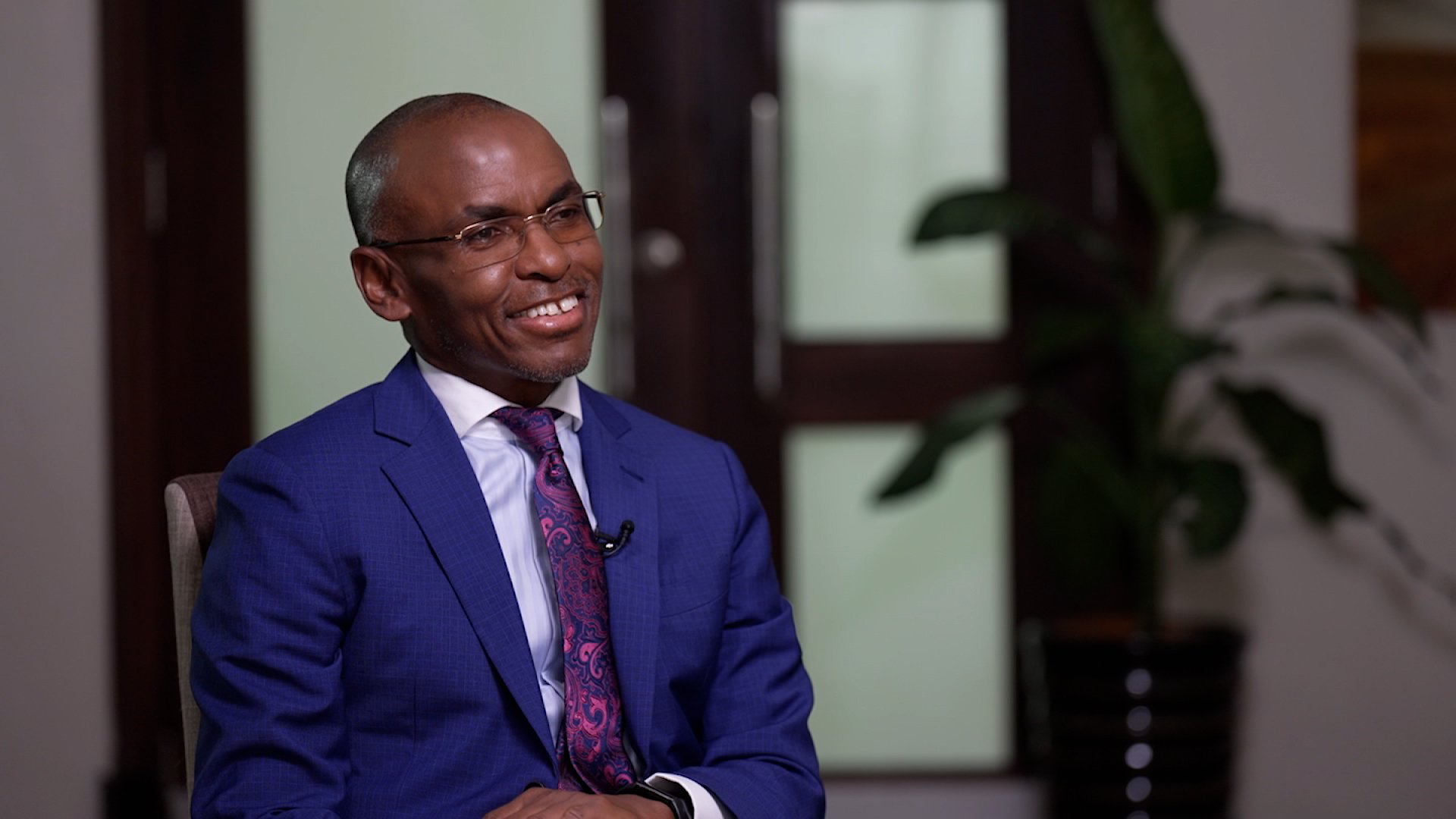
Safaricom CEO Peter Ndegwa says the company plans to broaden its service portfolio and make it possible for customers to make payments, save, invest and access insurance services within the M-Pesa umbrella. In a CNN Profit Point interview with Victoria Rubadiri, he framed the shift as part of a larger ambition to turn Safaricom into Africa’s leading purpose-led technology company, moving beyond traditional telecommunications by using technology and innovation to address real customer and societal needs.
The conversation explores the growing importance of artificial intelligence in protecting customers and securing digital transactions. Safaricom processes approximately 150 million transactions a day, making fraud prevention a significant priority as digital financial services expand. Ndegwa explains that AI and data are essential to identifying and preventing fraudulent activity, noting, “We can’t manually be able to prevent fraud if we didn’t have AI and we have a data layer.”


The programme also examines competition from banks and fintech companies as M-PESA expands its financial services offering. Ndegwa says Safaricom continues to reinvent itself to meet changing customer needs, adding, “Financial institutions like banks and insurance companies are competitors, but they’re also partners.”
The current push to democratize a fuller set of financial products continues Safaricom’s long-held approach to addressing user needs even as evolving pressures keep reshaping the platform’s evolution.
Steps To Expand M-PESA Services
Mr Ndegwa described the practical steps now under way. Safaricom already processes roughly 150 million transactions a day. At that volume, manual fraud detection is impossible; AI and the underlying data layer are essential to identify anomalies in real time. The same data capabilities are being applied to the company’s new “one app” super app, launched in Kenya, which uses personalization to bring payments, savings, merchant tools and other services into a single interface.
For businesses, the goal is operational utility in terms of accepting customer payments, settling suppliers and paying staff. These businesses use M-PESA as infrastructure for commerce rather than merely a consumer wallet.
Mr Ndegwa notes that Safaricom continues to reinvent itself around changing customer needs rather than attempting to lock out every adjacent player. The company is also investing heavily in the connectivity that underpins everything else, spending approximately $400–500 million a year on Kenyan infrastructure to expand capacity as data demand grows.
Expansion into Ethiopia remains part of it approach to replicate the combination of network scale and financial services in a larger market while adapting to local conditions.
The M-Pesa diversification strategy balances two constraints that have always shaped M-PESA. First, commercial discipline based on the platforms position as a major revenue contributor and a lock-in mechanism for Safaricom and second, its role in financial inclusion.
Ndegwa emphasizes on AI for security and on a super-app experience is one response to the overflows created by scale itself: more users and higher transaction volumes generate new risks and new opportunities for personalization.
Ndegwa highlights Safaricom’s ambition to bring services together through its “one app” super app, which has launched in Kenya. By using AI to personalise the experience, the platform aims to help individuals access services in one place while enabling businesses to manage their operations more effectively. Ndegwa reflects on the importance of balancing commercial performance with societal impact, saying that Safaricom and M-PESA embody a commitment to both.
Watch the full interview on CNN International’s Marketplace Africa on Saturday, 24 October 2026, at 6:30 a.m. East African Time, featuring Peter Ndegwa’s reflections on Safaricom’s transformation and the future of M-PESA across Africa.
ALSO READ: Safaricom CEO Calls for Cybersecurity to Be Built Into AI Frameworks