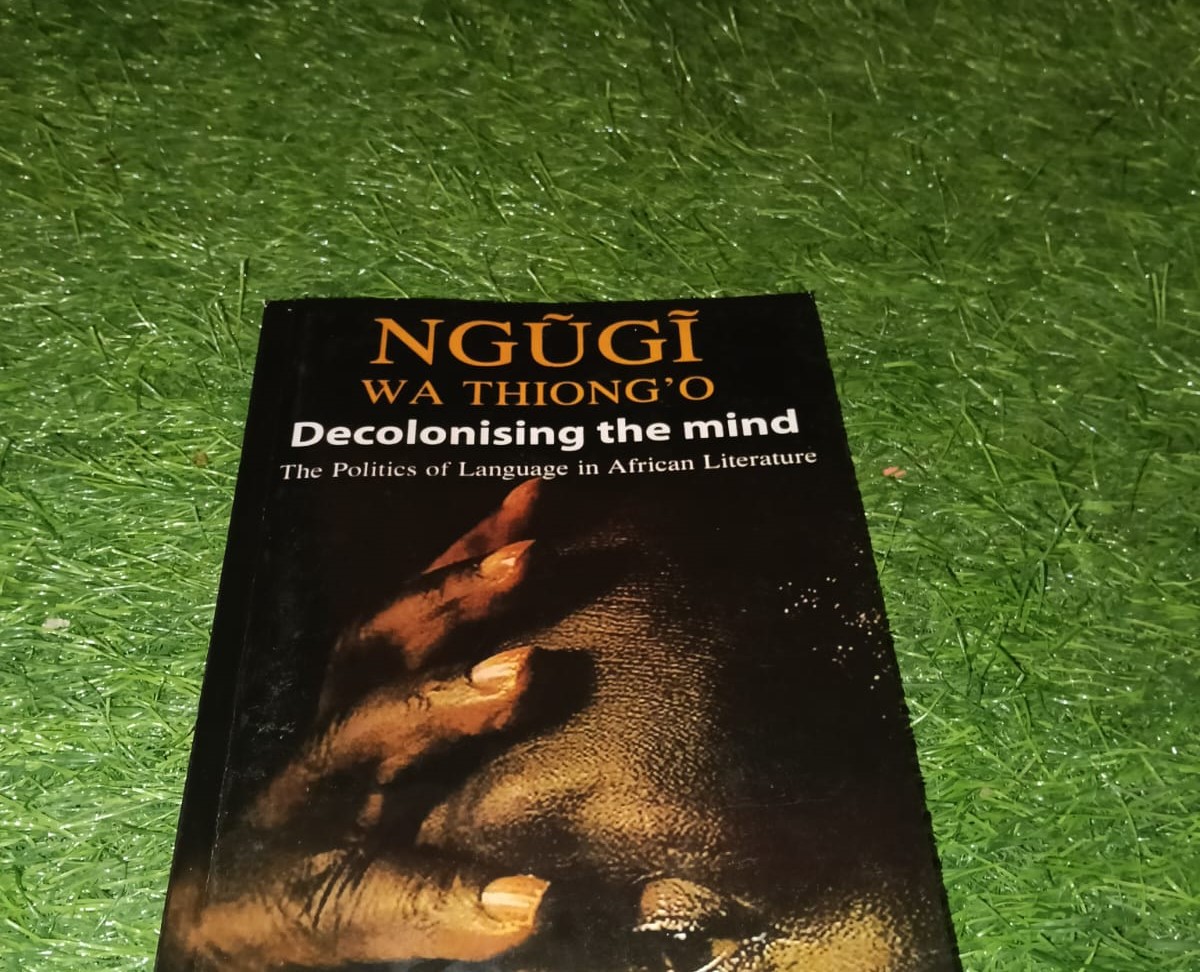
What does it mean to be independent when the language you use to understand yourself, the history you learn in school and the standards by which you judge your culture are inherited from the people who colonised you? This is the fundamental question at the heart of ‘Decolonising the Mind,’ one of the most influential works of African literary criticism by Kenyan writer Ngũgĩ wa Thiong’o.
Published in 1986, the book challenges Africans to examine the enduring psychological and cultural consequences of colonialism, particularly the dominance of European languages in African education, literature and public life.


Ngũgĩ argues that colonialism did not depend solely on military conquest, political domination or economic exploitation. It also sought to reshape how colonised people understood their world. Language became one of its most powerful instruments, influencing what people valued, how they interpreted their experiences and which cultures they considered worthy of respect.
Here are 5 lessons for African Youth in Ngugi Wa Thiong’o’s book ‘Decolonising The Mind.’
-
Language is more than a means of communication
One of the most powerful arguments in Decolonising the Mind is that language carries culture, memory, values and a people’s understanding of the world. It is not simply a collection of words used to exchange information. It shapes how people interpret their experiences and communicate their identity to future generations.
Ngũgĩ explores how colonial education elevated European languages while diminishing the status of African languages. In the colonial classroom, a child’s mother tongue could be treated as inferior, while proficiency in English or another European language became a marker of intelligence, discipline and social advancement.
The consequence, Ngũgĩ argues, was a separation between the language of a child’s home and community and the language through which that child was expected to acquire knowledge and succeed in society.
For African children, this could create a troubling contradiction. They might grow up learning that their grandparents’ stories, community traditions and everyday expressions belonged to a world of limited prestige, while foreign cultural references represented sophistication and achievement.
This lesson remains particularly important in Kenya, where English and Kiswahili play central roles in education and public life, alongside dozens of indigenous languages. The challenge is not that English should be abandoned, but that fluency in it should not require contempt for the languages in which many Kenyans first understand the world.
African societies can respond by investing in mother-tongue education, translating important works into indigenous languages and expanding the use of African languages in public communication, literature and digital technology.
The deeper lesson is that a people who lose confidence in their language risk losing confidence in the knowledge and experiences that language carries.
-
Education should liberate the mind, not reproduce colonial hierarchies
Ngũgĩ’s critique of colonial education is among the book’s most enduring contributions. He challenges an educational system that can train Africans to admire foreign cultural traditions while giving inadequate attention to the histories, intellectual achievements and lived realities of their own societies.
Education, in this sense, becomes more than the acquisition of knowledge. It becomes a process through which a society determines whose knowledge matters, whose history deserves to be remembered and whose worldview is considered legitimate.
The implications extend beyond literature. An education system that presents Africa mainly through colonial conquest, poverty and crisis risks producing graduates who struggle to recognise the continent as a source of scientific innovation, political thought, philosophy and creative achievement.
Consider the Kenyan student who can identify European literary classics but has little exposure to the intellectual traditions of African societies, the history of African political movements or the development of indigenous systems of knowledge. The problem is not familiarity with European literature. It is the imbalance that emerges when one intellectual tradition is treated as universal while others are regarded as peripheral.
Ngũgĩ’s argument therefore invites a reconsideration of curricula, reading lists and the broader purpose of education.
Schools and universities should expose students to global scholarship while giving African histories, literature and intellectual traditions the depth they deserve. Students should be encouraged to examine the continent critically, including its failures, rather than being taught either to romanticise Africa or to view it exclusively through the lens of its problems.
For policymakers, this means evaluating educational quality not only through examination results and employment outcomes but also through the ability of learners to think independently, understand their societies and contribute to solving local challenges.
The lesson is that education should equip Africans to engage with the world without teaching them to regard their own societies as intellectually inferior.
-
Cultural identity is a foundation for development, not an obstacle to modernisation
A central message in Decolonising the Mind is that Africa does not have to surrender its cultural identity to participate in the modern world.
Colonialism often presented European cultural practices and institutions as the standard of civilisation. The legacy of this thinking can persist when African languages, art forms, oral traditions and social experiences are dismissed as outdated or unsuitable for modern life.
Ngũgĩ challenges this hierarchy by insisting that African cultural expression deserves to be taken seriously in its own right. His argument is particularly clear in his discussion of theatre and literature, where he explores the relationship between creative expression and the communities from which it emerges.
His experience with community theatre in Kenya, including the Kamĩrĩĩthũ cultural project, informs this position. Theatre performed in Gikuyu could connect directly with ordinary people, drawing on familiar language and experiences rather than depending exclusively on institutions and audiences shaped by colonial conventions.
The wider lesson is that cultural identity need not be preserved only in museums, ceremonial performances or national holidays. It can remain active in contemporary life.
African languages can support modern scientific discussion. Indigenous storytelling can inform films, animation and digital publishing. Traditional knowledge can be studied alongside contemporary research, with appropriate scrutiny and evidence. African music, fashion, literature and visual art can contribute to international markets without losing their distinctive perspectives.
For Kenya, the opportunity lies in treating cultural industries not merely as entertainment but as potential sources of employment, entrepreneurship and intellectual influence.
However, cultural preservation should not mean defending every tradition against criticism. African societies contain practices that deserve examination and reform, just as every other society does. Respect for heritage must coexist with human rights, scientific evidence and individual freedom.
Ngũgĩ’s argument is strongest when understood as a demand for cultural equality rather than cultural isolation.
Modernisation does not require Africans to become less African. It requires them to participate in modern life without being ashamed of their origins.
-
African stories must be told from African perspectives
Who has the authority to tell Africa’s story? And what happens when the continent is predominantly represented through narratives created for audiences outside it?
These questions run through Ngũgĩ’s discussion of African literature. He challenges the assumption that African writers must use European languages to reach serious readers or produce work of lasting literary value.
His decision to write in Gikuyu, including works such as Caitaani Mũtharaba-Inĩ, published in English as Devil on the Cross, represented a practical expression of his argument. Rather than simply defending African-language literature in theory, he sought to create it and engage readers in the language of his community.
The significance extends beyond the choice of language. Stories influence how people understand their history, define their aspirations and imagine their place in the world.
When African experiences are repeatedly presented through external assumptions, local complexities can disappear. Communities may be reduced to stereotypes, political developments interpreted without sufficient historical context and economic challenges explained without adequate attention to local agency.
African writers, journalists, filmmakers and researchers therefore have an important role in producing work that reflects the continent’s diversity and complexity.
This does not mean that only Africans can write meaningfully about Africa. Nor does it mean that foreign audiences should be excluded from African literature. Rather, it means that African voices and intellectual traditions should have the resources, platforms and recognition needed to shape global conversations.
There is also an important economic dimension. Translation, local-language publishing, independent film production and digital storytelling can create markets for creative work while expanding access to knowledge.
For African media organisations and publishers, the question is whether their business models and editorial choices give sufficient space to stories originating in African communities and told with an understanding of their histories.
The lesson is that Africa should not be merely the subject of global narratives. It should also be an influential producer of the ideas through which the world understands Africa.
-
Intellectual freedom requires questioning inherited standards of success
Perhaps the most uncomfortable implication of Decolonising the Mind is that colonial influence can survive without direct colonial rule.
A country may have its own flag, constitution, parliament and national institutions while continuing to attach disproportionate prestige to foreign languages, cultural references and intellectual standards. The persistence of these attitudes is part of what makes Ngũgĩ’s argument relevant long after formal independence.
In practical terms, this can be seen whenever people equate an accent with intelligence, assume that foreign qualifications are automatically superior to local expertise or dismiss African-produced knowledge before evaluating its quality.
Such attitudes can affect public policy, education, business and individual ambition. They may lead institutions to overlook capable local researchers, businesses to undervalue domestic innovation or young people to believe that meaningful intellectual achievement requires validation from abroad.
The solution, however, is not to reverse the hierarchy by dismissing everything foreign. That would replace one form of intellectual dependence with another.
Instead, Africans need the confidence to assess ideas on their merits. European, Asian and American knowledge can be valuable, just as African knowledge can offer important insights. What matters is whether evidence, relevance and intellectual rigour determine the value assigned to an idea.
For African governments and universities, this requires investment in research, local publishing, scientific communication and institutions capable of producing knowledge that responds to African conditions.
For individuals, it means developing the habit of asking why certain standards are accepted, whose interests they serve and whether they remain appropriate for the problems being addressed.
For young Africans, the message is particularly important in an interconnected world. Global exposure is an advantage, but it should expand intellectual independence rather than create a permanent dependence on external approval.
Decolonising the mind is ultimately about acquiring the freedom to think critically, choose intelligently and determine one’s own intellectual direction.
Where Ngũgĩ’s argument is most persuasive
The enduring strength of Decolonising the Mind is its ability to reveal the political significance of something that people often take for granted: language. By connecting language to education, culture and power, Ngũgĩ encourages readers to question assumptions that may otherwise appear natural or inevitable.
The book is also compelling because its arguments are grounded in the author’s own literary journey. Having initially written novels and plays in English, Ngũgĩ later made a deliberate commitment to Gikuyu. His position is therefore not simply theoretical; it is reflected in his creative practice. The publisher’s description and the book’s four essays place language at the centre of questions about African literature, theatre, fiction and cultural relevance.
Nevertheless, the book’s central argument invites debate.
The strongest objection concerns the extent to which language determines cultural identity and intellectual independence. African societies are multilingual, and identities are shaped by many factors beyond language, including class, religion, migration, technology and political experience. People can express deep connections to African cultures in English, French or Portuguese, just as speaking an indigenous language does not automatically make someone culturally conscious or politically independent.
European languages also serve practical purposes across national and ethnic boundaries. English, for example, enables communication among people who may not share a mother tongue and provides access to international research, education and trade. Abandoning it would be neither necessary nor sufficient to achieve intellectual independence.
A more useful reading of Ngũgĩ is therefore not that Africans must reject European languages, but that they should reject the idea that these languages are inherently superior to African ones.
There are also practical questions about implementation. Expanding education and scientific communication in African languages requires investment in terminology development, textbooks, teacher training, translation and publishing. In multilingual countries, decisions about which languages receive institutional support can become politically sensitive. These challenges cannot be resolved by cultural conviction alone; they require sustained public policy and resources.
Yet these limitations do not undermine the book’s central contribution. They sharpen the debate by forcing readers to distinguish between the benefits of multilingualism and the harmful hierarchies that colonial history helped establish.
Ngũgĩ’s work is most persuasive when it is read as an invitation to expand intellectual freedom, rather than as a prescription for linguistic purity.
A book African youth should read and debate
Decolonising the Mind remains an important work for anyone interested in African identity, postcolonial thought, education and the politics of culture. Its greatest achievement is that it turns language from an apparently ordinary feature of daily life into a question of power, dignity and self-determination.
The novel raises questions about the languages used in classrooms, public institutions and scientific research. For educators, it challenges curricula that fail to give African intellectual traditions sufficient recognition. For writers and journalists, it highlights the importance of representing African experiences without surrendering interpretive authority. For ordinary readers, it encourages a closer examination of the assumptions they have inherited about their own cultures.
Ngũgĩ asks Africans to consider whether independence is complete when the mind remains constrained by inherited hierarchies. His answer is that genuine freedom requires more than political sovereignty. It requires the confidence and institutional capacity to think, create and communicate without treating one’s own cultural inheritance as a disadvantage.
For readers seeking a deeper understanding of Africa’s postcolonial experience, Decolonising the Mind is well worth reading. It is a challenging, sometimes uncompromising book whose relevance keeps growing.
ALSO READ: What Kenya Can Learn from Adam Smith’s ‘The Wealth of Nations’