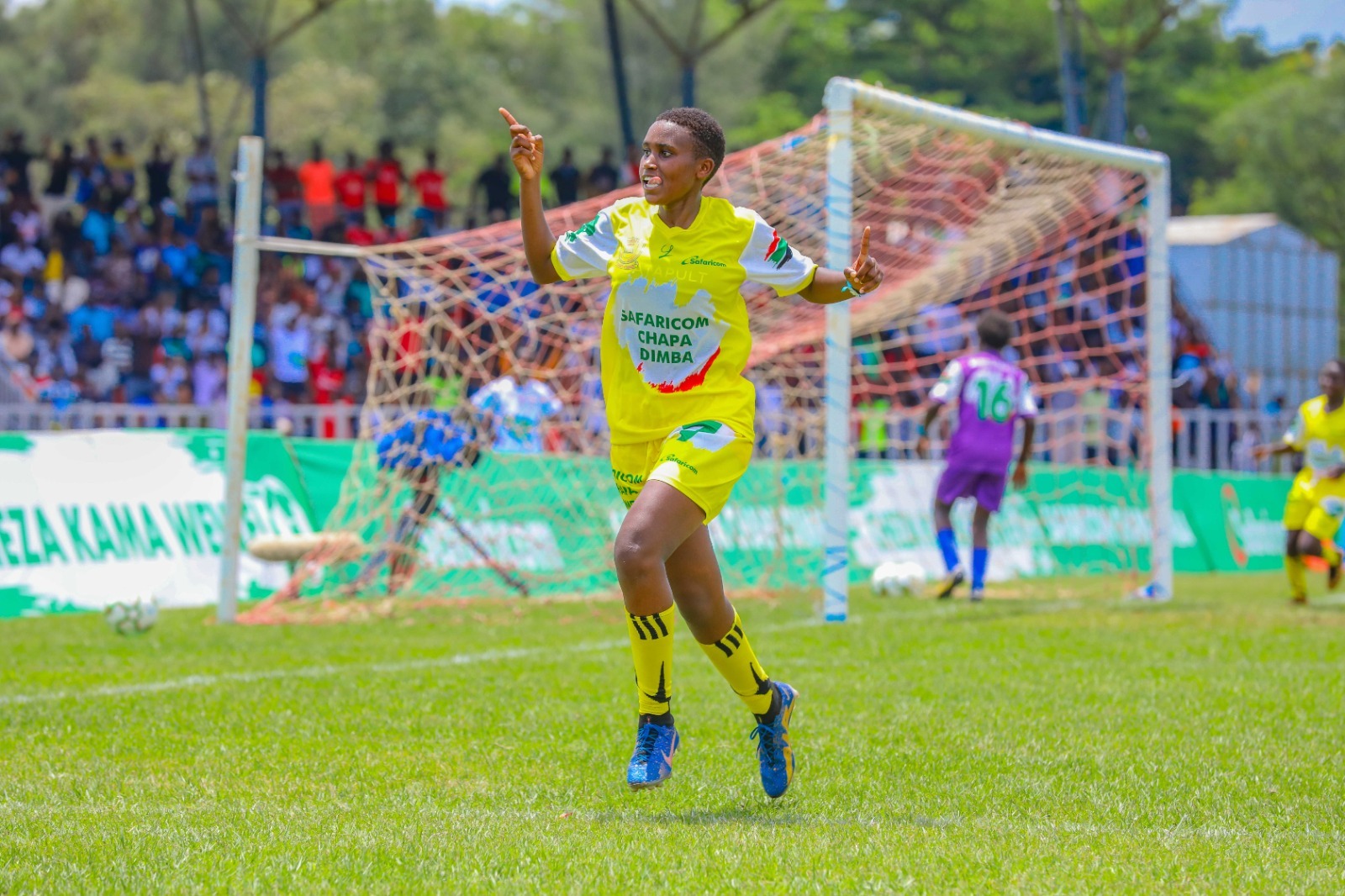
When Ibrahim Abdisalan stepped onto the touchline at Moi Stadium in Embu last October, the roar that followed MAFA Academy’s 8-0 thrashing of Mikinduri Rock-Star FC was more than a celebration of a maiden regional title. It was the sound of a full-circle loop that has drawn admiration from Kenya’s growing football industry.
Coach Abdisalam says Safaricom Chapa Dimba opened doors for him and he is delighted to share his experience with an upcoming cohort of aspiring professional footballers.


“Personally, Chapa Dimba took me to Spain, and now, coming back as a coach and winning the regional title is something I am very happy about,” an overjoyed Abdisalan said after the regional final match.
The Isiolo-based side, which had prepared for two years for this moment, took their chances with clinical efficiency and pocketed KES 250,000, smartphones and a ticket to the national finals.
Abdisalan is a Chapa Dimba alumnus. He came through the tournament as a player, earned a place on an All-Star squad that travelled to Spain for and elite training program, and has now returned as a coach guiding the next cohort. His journey is inspiring young football players at the grassroots level to grow and reach professional status.
Safaricom Chapa Dimba Became A Talent Pipeline
Launched in 2017, Safaricom Chapa Dimba has grown into Kenya’s most structured grassroots football platform. This year is the tournament’s Season 5. It has attracted a record 3,178 teams; 2,367 boys’ and 811 girls’ teams. The age bracket was deliberately lowered from 16–20 to 15–18 to catch talent earlier and give coaches and scouts more years to develop players before they age out of junior pathways.
Chapa Dimba’s continued expansion across multiple counties offers a useful window into the depth of grassroots football talent in Kenya, particularly among players who may not have access to established professional academies or high-profile scouting networks.
The competition also creates a pathway for girls’ football, which can face additional barriers in accessing coaching, competitive matches, equipment and exposure to talent scouts. By maintaining separate boys’ and girls’ categories, Chapa Dimba provides a competitive environment in which both groups can pursue regional honours and national recognition.
The structure is a progressive one. Teams compete at the ward level, then proceed to the county level, then the inter-county level, then the regional level, and finally, the national level. Regional winners take home KES 250,000 while runners-up receive KES 150,000. National champions for both the boys and girls categories receive KES 1 million. There are also individual awards reserved for Best Goalkeeper, Top Scorer, and Most Valuable Player who also get a fully funded tertiary scholarship under the Citizens of the Future programme.
Off the pitch, clinics cover financial literacy, mental health, data privacy and the use of wearable GPS technology and AI-powered tracking (VeO cameras and MyScout tools). These generate digital player profiles that scouts and clubs can access.
It is the inspiring stories like that of Ibrahim Abdisalan that show the evidence of how important Chapa Dimba has become in developing the professional game in the country. Former Gor Mahia forward Benson Omala is one of the most prominent recent graduands of the Chapa Dimba pipeline and is now a full professional with multiple national team appearances to his name.
How Does the Safaricom Chapa Dimba Tournament Work?
The competition progresses through different stages, beginning with county-level contests before advancing to regional finals and ultimately the national finals.
At the county stage, teams compete for local honours and the opportunity to represent their counties at regional level. In Nyanza, for example, the county finals covered Kisumu, Homa Bay, Migori, Siaya, Nyamira and Kisii, with the successful teams advancing to the regional competition.
The regional stage brings together leading teams from across the participating counties. Depending on the region, the format includes playoffs, quarter-finals or pool matches, followed by semi-finals and finals.
In the Eastern Region, 16 teams competed in the regional tournament, with eight boys’ teams and eight girls’ teams. The competition moved from the quarter-finals to the semi-finals before the regional champions were decided at Moi Stadium in Embu.
Nyanza used an inter-county playoff and pool-stage format, with teams competing for places in the semi-finals and finals. These different formats reflect the need to accommodate the number of qualifying teams while producing regional champions.
The boys’ and girls’ winners from each region then earn the opportunity to represent their respective regions at the national finals. This progression gives teams several competitive milestones to pursue, rather than making the entire season dependent on a single national tournament.
Regional winners so far this season are Vihiga Cranes and Lugari Progressive (Western), Awendo Football Academy and Plateau Queens (Nyanza, with Plateau defending their regional crown for a third time), St. Joseph Starlets and LYSA (Central, ending Barcelona Rising Starlets’ run), and now MAFA Academy and MCF Starlets (Eastern). These teams, plus those still to emerge from Coast, Rift Valley, North Eastern and Nairobi, will contest the national finals.
Talent Identification At Chapa Dimba
Talent identification is one of the tournament’s central attractions. By bringing teams together in organised regional competitions, the event gives scouts an opportunity to watch players in competitive situations rather than relying solely on informal recommendations or training-ground assessments.
Safaricom’s Chief Consumer Business Officer, Fawzia Ali, says scouts attended the Nyanza regional finals and expressed confidence that some players could progress to local and international clubs.
“We had scouts on the ground, and I believe they have identified some great talent. I am sure we will see some of these Chapa Dimba players going on to play for local clubs and even securing opportunities with international clubs,” Ali said.
Her comments capture the ambition behind the tournament. Being identified by a scout is an important first step in a long process that can involve trials, continued training, physical development, education and the availability of opportunities at clubs.
The tournament’s pathway extends beyond the national finals. The Season Five All-Star Team is expected to represent Kenya at the Gothia Cup in Sweden, the world’s largest youth football tournament.
International competition can expose young players to different playing styles, tactical approaches and levels of competition. It can also help them experience football in a new environment and understand the demands of performing against unfamiliar opponents.
For the players selected, the opportunity would represent an additional stage in their development. It could also give coaches and scouts a broader setting in which to assess how promising footballers adapt to different opponents.
The trip is an opportunity for the selected All-Star Team to compete with other young players from elite football academies from around the world.
What Happens Next in Safaricom Chapa Dimba Season Five?
With the Western, Nyanza and Eastern regional finals completed, the competition is moving towards the next regional stage in Nairobi.
The qualified teams will ultimately meet at the national finals, scheduled for early 2027. The national competition will determine which sides emerge as the season’s overall champions.
For the regional winners, the immediate challenge is to maintain their form against teams that have progressed through different competitive environments. A commanding regional victory does not necessarily guarantee national success, as the later rounds bring together sides that have already overcome multiple stages of competition.
Is Safaricom Chapa Dimba Making a Difference to Grassroots Football?
The tournament’s broader significance lies in its attempt to connect grassroots participation with more structured development opportunities.
Its regional format gives teams from counties such as Isiolo, Migori, Vihiga and Machakos a route to national competition. The individual awards recognise exceptional performances, while the scholarship component links sporting achievement with education. The clinics introduce players and coaches to subjects that can influence their wellbeing and development beyond the pitch.
The positivity from participating coaches also indicate that the tournament can become part of a team’s longer-term plans. MAFA Academy’s preparation over two years, for example, suggests that some teams view Chapa Dimba as a major competitive target rather than a one-off event.
Abdisalam’s story remains inspirational for the thousands of 15- to 18-year-olds still chasing a place on the pitch. Chapa Dimba has turned what used to be informal street and school football into a documented, resourced and increasingly international pipeline. One coach who was once on that plane to Spain is now on the sidelines to ensure the circle can keep turning.
ALSO READ: Safaricom Ethiopia Surpasses 15 Million Subscribers as It Marks Five Years