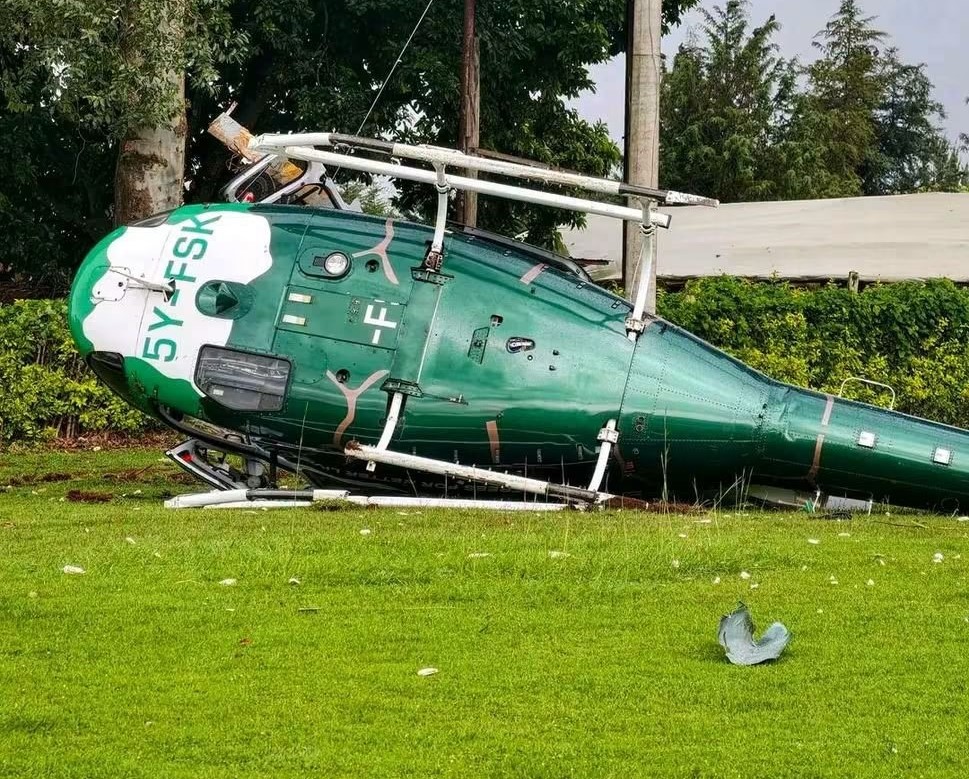
A helicopter carrying Environment PS Festus Ng’eno crashed at Kericho Golf Club on Monday, amid heavy rains in the area.
The incident, which involved a Kenya Forest Service (KFS) helicopter, occurred as the aircraft attempted to take off from the golf club grounds in Kericho County.


The crash has drawn attention to the risks of helicopter operations during unfavourable weather conditions, particularly as Kenya enters the October–December rainy season, when heavy rainfall and poor visibility can complicate air and road transport.
What Happened To Environment PS Festus Ng’eno?
The helicopter, registration number 5Y-FSK, was carrying six people when the accident occurred on Monday afternoon. Witness accounts indicated that the aircraft had barely gained altitude after take-off before losing height and crashing onto the golf club grounds.
Kericho County Police Commander Kivindu Kilonzo confirmed that several occupants had sustained injuries, while no fatalities had been reported in the initial assessment. The injured were rescued from the wreckage and taken to South Rift Hospital for urgent medical attention.
The helicopter sustained extensive damage, with photographs from the scene showing the tail section separated from the main fuselage. Emergency responders and security personnel were dispatched to assess the situation.
Although the initial reports established that heavy rains were prevailing in the area, the precise circumstances that led to the crash had not been determined at the time of publication. Investigators will need to establish whether weather conditions, technical issues, operational factors or a combination of circumstances contributed to the accident.
Who Is Environment PS Festus Ng’eno?
Festus K. Ng’eno serves as the Principal Secretary in Kenya’s State Department for Environment and Climate Change. His responsibilities include supporting the implementation of government environmental policies and coordinating initiatives related to environmental protection and climate change.
Ng’eno has also been involved in public discussions on Kenya’s preparedness for the October–December 2026 rainy season. In August, he called for stronger collaboration and early action to ensure that climate forecasts translate into practical measures to protect lives, livelihoods and the economy.
His presence among the passengers involved in the Kericho helicopter crash adds significance to an incident that would otherwise have been primarily an aviation safety story. However, the immediate priority remains the medical care of those injured and the establishment of the facts surrounding the accident.
Heavy Rains Raise Questions About Aviation Safety
The crash comes as Kenya prepares for a period of enhanced rainfall during the October–December 2026 season. The Kenya Meteorological Department has warned of above-average rainfall across much of the country, raising concerns about weather-related hazards, including flooding and disruption to transport.
Heavy rainfall can create challenging conditions for aviation, particularly when accompanied by low cloud cover, reduced visibility, strong winds or other adverse weather. Helicopters can operate in a range of environments, but safe operations depend on the aircraft, the pilot’s qualifications, prevailing conditions and the applicable operational limits.
A key issue in the Kericho incident will be whether weather conditions affected the helicopter’s take-off and whether the flight was operating within the relevant safety requirements. These questions cannot be conclusively answered from eyewitness accounts or the presence of heavy rain alone.
It is important not to attribute the crash solely to heavy rainfall until the findings of the relevant aviation authorities are available.
A Renewed Focus on Kenya’s Aviation Safety Record
The Kericho incident comes amid renewed attention to aviation safety following other aircraft accidents reported in Kenya in recent months.
A recent helicopter crash near Mount Ololokwe in Samburu County in August 2026 killed all seven people on board. In September, a light training aircraft operated by the Kenya School of Flying crashed in the Kipeto area of Kajiado West Sub-County, killing a student pilot and a flight instructor.
Although each accident must be investigated on its own facts, such incidents underscore the importance of robust aviation safety procedures, effective maintenance, appropriate pilot training and sound decisions when weather conditions deteriorate.
The Kericho crash also highlights the importance of prompt emergency response. The reported evacuation of the injured to hospital is a critical first step, while the preservation and examination of the crash site will help investigators establish what happened.
The immediate focus is on the recovery of the injured passengers and the investigation into the circumstances of the crash. Authorities will need to establish the cause of the accident and determine whether any operational, mechanical or environmental factors contributed to it.
The Kenya Civil Aviation Authority and the relevant aircraft accident investigation bodies have important roles in ensuring that aviation incidents are examined appropriately and that any safety lessons are identified.
ALSO READ: Uhuru Park Leasing Plan Stopped By Court