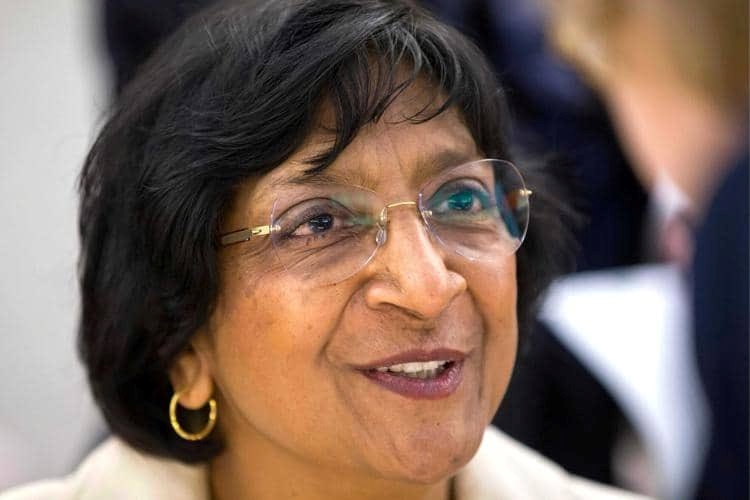
South African judge Navanethem “Navi” Pillay has won the 2026 Nobel Peace Prize for her efforts to promote peace and international law, the Norwegian Nobel Committee has announced.
The committee said this year’s laureate had led the way toward a more comprehensive global legal order and had been instrumental in ensuring that war crimes, crimes against humanity and genocide are prosecuted.
“A common thread runs from her early work defending Nelson Mandela and others who stood up against apartheid to her service as a judge in some of the key international court cases of our time,” the Nobel Committee said.
Nobel Committee Chair Jørgen Watne Frydnes told reporters that the system of international law was under tremendous pressure and that the world was seeing a shift toward power politics at the expense of legal frameworks. He had not reached Pillay before the announcement. His message, he said, was that if she saw a Norwegian number calling, she should pick up.
Pillay was born on 23 September 1941 in Durban, into a family of Indian Tamil origin under apartheid. She founded her own law firm in 1967, one of the first Black women in South Africa to do so, and spent years defending anti-apartheid activists, including clients connected to the Robben Island trials. In the 1980s she studied at Harvard and earned a doctorate in juridical science in 1988.
Her work is seen as courtroom defence against a state that treated political opposition as a crime.
Judge Navi Pillay Legal Journey
After the transition from Apartheid South Africa, she was appointed to the High Court in 1995. In 1999 the UN General Assembly elected her to the International Criminal Tribunal for Rwanda. She served eight years, four of them as president. The tribunal’s lasting mark, and hers, was the finding that rape and sexual violence, and the spreading of genocidal propaganda, could themselves ground charges of genocide and crimes against humanity. That reading moved sexual violence out of the category of a private wartime abuse and into the core of international criminal law.
Navi Pillay then sat as a judge of the International Criminal Court from 2003 to 2008. From 2008 to 2014 she was United Nations High Commissioner for Human Rights, the UN’s most senior human-rights post, using it to press states on accountability rather than on quiet diplomacy alone.
From 2021 to 2025 she chaired the UN Independent International Commission of Inquiry on the Occupied Palestinian Territory, a role that drew sharp political criticism and that the committee still placed inside the same career of holding states and leaders to legal standards. Since 2019 she has been an ad hoc judge at the International Court of Justice in the case in which Myanmar stands accused of genocide.
The committee attached weight to her judicial rigour, personal integrity and courage, at a moment when the number of wars is rising and judges and courts are under political attack. The prize is a reminder that conflicts are resolved without force only if the international rule of law holds. The award is worth 12 million Swedish kronor and will be presented in Oslo on 10 December. Venezuelan opposition leader María Corina Machado won the peace prize in 2025.
The choice also lands in a year when the prize itself became a political target. The committee did not name any disappointed claimant. It recognized Pillay as a dedicated lawyer who began her work under apartheid, a judge who helped define genocide law at the Rwanda tribunal, a commissioner who spent six years at the head of the UN human rights office.
ALSO READ: DRC Prime Minister Abruptly Steps Down