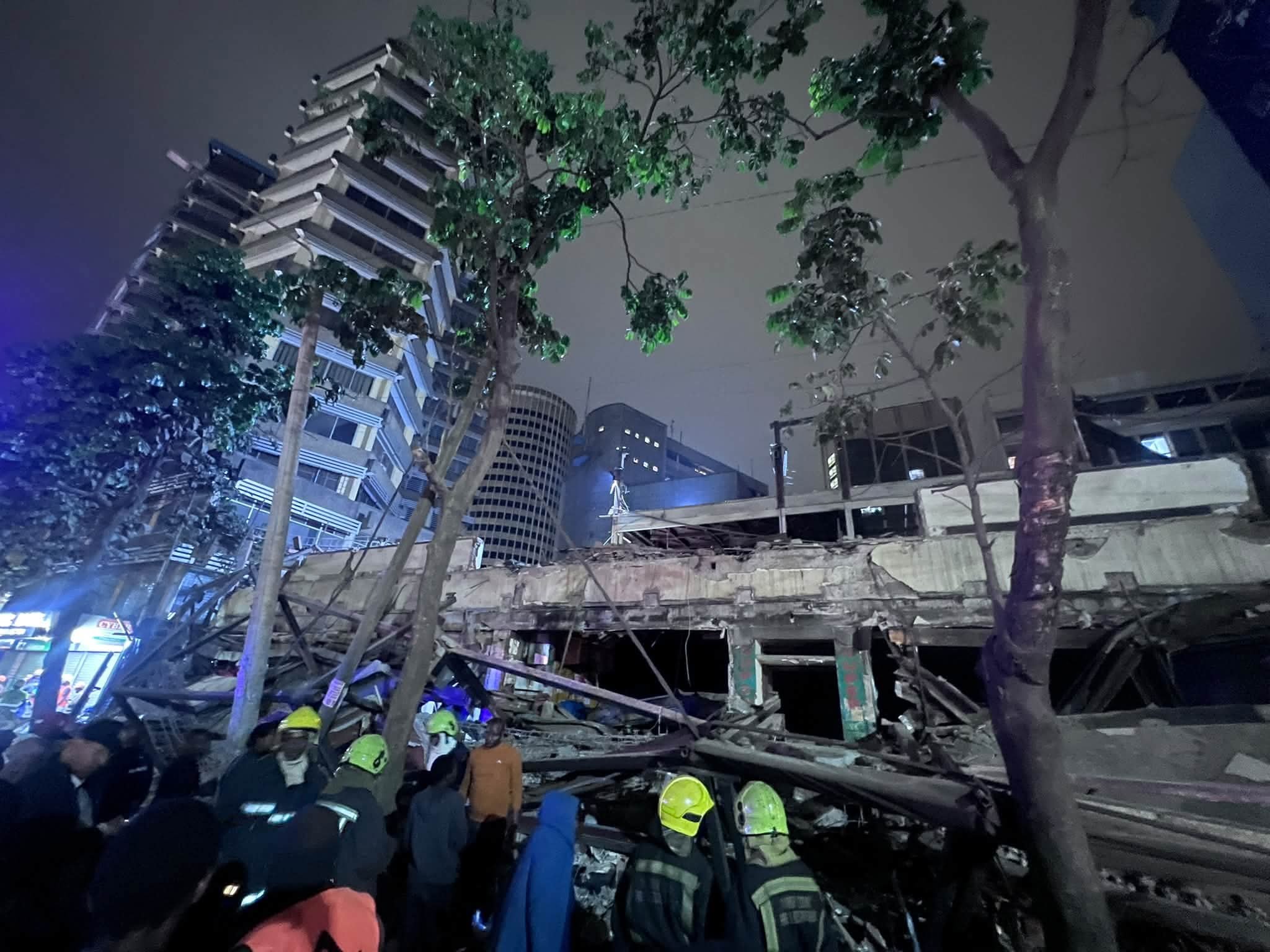
At least four people were injured after a building collapsed during demolition works along Moi Avenue in Nairobi’s Central Business District (CBD) early Saturday morning.
Police said the injured people were working at the site when the incident occurred at approximately 2 am. Emergency responders and police officers rushed to the scene after the collapse, amid initial fears that several people could be trapped beneath the debris.


The incident brings attention to the risks associated with demolition work in a densely built commercial district where buildings stand close to one another and workers may operate during hours when fewer people are present to witness an accident.
The circumstances surrounding the collapse, including what caused the structure to give way and whether the demolition was being conducted under the required safety procedures, were not immediately established.
Former Club Avenida Building Along Moi Avenue Collapses
The building, which formerly housed Club Avenida, collapsed during a nighttime demolition exercise. The premises are located along Moi Avenue, near MKU Union Towers in Nairobi CBD.
Nairobi City County Chief Officer for Citizen Engagement and Customer Service Geoffrey Mosiria confirmed the incident and called for a detailed investigation into the circumstances surrounding the collapse.
Mosiria said the fact that the incident happened at night, when pedestrian and vehicle traffic was relatively low, may have prevented a more serious tragedy. He nevertheless emphasised the need to establish what went wrong and whether the demolition complied with the applicable safety requirements.
Reports from the scene indicated that four people were injured. Some media reports subsequently indicated that three of the injured were in stable condition, while one had sustained critical injuries. The full circumstances of their injuries were not independently established in the initial reports.
Investigation to Examine Demolition Safety
The Nairobi CBD building collapse has placed the focus on how demolition projects are planned, supervised and executed, particularly in busy commercial areas where structural failures can endanger workers and the public.
Mosiria called on county engineers to investigate the cause of the collapse, establish whether qualified professionals were supervising the demolition and verify whether the necessary county approvals had been obtained.
“I call upon our county engineers to conduct a thorough investigation into this specific demolition to establish the cause of the collapse, determine whether qualified experts were involved to guide the demolition, and verify whether all the necessary demolition approvals had been obtained,” he said.
The investigation will be important in determining whether the collapse resulted from structural weaknesses, the demolition method used, inadequate technical supervision or other factors. Until the findings are made public, it would be premature to assign responsibility or conclude that any particular safety requirement was breached.
Demolition work presents distinct engineering challenges because removing structural components can alter how a building distributes its weight. A sequence that is poorly planned or inadequately supervised can leave remaining sections unstable, potentially causing an uncontrolled collapse.
For this reason, demolition projects require appropriate structural assessments, a carefully planned sequence of work, competent technical supervision and measures to keep unauthorised people away from hazardous areas. In a densely populated commercial district, these precautions must also account for neighbouring buildings, pedestrians, motorists and other businesses.
Developers Urged to Prioritise Public Safety
Mosiria also urged developers to comply with county regulations governing construction and demolition and to work closely with county engineers to protect lives.
“I appeal to all developers to strictly comply with county laws during construction and demolition and work closely with county engineers to ensure safety and protect lives,” he said.
His call highlights a broader question about the effectiveness of regulatory oversight in Nairobi’s rapidly changing built environment. As older commercial properties are redeveloped to accommodate new uses, demolition must be treated as a technically demanding operation rather than simply the removal of an unwanted structure.
Obtaining the required approvals is an important part of that process, but effective safety management also depends on what happens on the ground. Investigators need to establish whether the demolition plan was suitable for the building, whether the work followed the approved sequence and whether workers had adequate protection.
Accountability is equally important. If an investigation establishes negligence or non-compliance, the relevant authorities will need to determine the appropriate action in accordance with the law. Transparent findings would help establish responsibility while providing practical lessons for future projects.
Nairobi CBD Building Collapse Raises Wider Safety Concerns
The Moi Avenue incident comes amid continued scrutiny of building safety in Nairobi following other structural failures in the capital.
In March 2026, a building collapsed during demolition work in Shauri Moyo, killing four people and injuring four others. The structure was associated with the Nairobi River Regeneration Project. The incident highlighted the potentially devastating consequences when demolition operations go wrong.
Although the circumstances of the Shauri Moyo incident may differ from those of the Moi Avenue collapse, both underline the importance of effective safeguards when structures are being dismantled.
For Nairobi, the challenge extends beyond responding to collapses after they occur. Prevention requires coordination among developers, contractors, qualified professionals and county authorities, supported by meaningful inspections and enforcement.
The location of the Moi Avenue collapse makes the issue particularly significant. The CBD is a major commercial hub where workers, traders, customers and commuters move through closely built streets. An incident occurring during a busier period could expose substantially more people to danger.
The fact that the collapse occurred at night may have reduced exposure to passing pedestrians and motorists, but the presence of workers at the site demonstrates that demolition activities remain hazardous even when public movement is limited.
The immediate priority is to establish the condition of the injured workers, confirm whether everyone at the site has been accounted for and ensure that the affected area is safe.
The subsequent investigation should clarify the technical circumstances of the collapse and whether the demolition had the necessary approvals and professional oversight. Its findings will be central to determining whether corrective action or further enforcement is required.
For developers undertaking similar projects, the incident is a reminder that safety planning, professional supervision and compliance with regulatory requirements are essential throughout the demolition process.
ALSO READ: Surveyors Warn Against Unlawful Demolitions in Nairobi